


SPECIFICATION LIFECYCLE
From idea to published standard
Every GSF specification follows a rigorous seven-stage lifecycle, ensuring quality, consensus, and real-world applicability.
Proposal
Requirements gathering from diverse stakeholders, defining scope and objectives, validating requirements.
Pre-Draft
Research and analysis, composing a preliminary technical specification draft.
Draft
Full specification with structured sections: introduction, scope, objectives, requirements, design, metrics, and compliance.
Consistency Review
Peer reviews, stakeholder feedback, and iterative refinement of the document.
Working Group Approval
Working group review, broader feedback incorporation, and formal sign-off.
Steering Committee Ratification
The Steering Committee officially approves the specification for public release.
Published
Public release, ongoing feedback, and maintenance. The standard is available for adoption.
Current Standards & Projects
Specifications at every stage of the lifecycle — from early proposals to internationally recognized standards.
Software Standards Working Group
 Published
 Software Carbon Intensity (SCI)
A specification that describes how to calculate a carbon intensity for software applications.
Learn more → Ratified
 Software Carbon Intensity for Artificial intelligence (SCI for AI)
Extending the Software Carbon Intensity (SCI) to Artificial intelligence (AI). Addressing the challenges of measuring Artificial intelligence carbon emissions
Learn more → Draft
Draft Software Carbon Intensity for Web (SCI for Web)
Extending the Software Carbon Intensity (SCI) to the Web. Addressing the challenges of measuring website carbon emissions
Learn more → Ratified
 Sustainable Organisational Framework for Technology (SOFT)
A framework for decision-making during the development, implementation, and operation of technology applications by incorporating all available methodologies and instruments.
Learn more → Published
 Real Time Energy and Carbon Standard for Cloud Providers (RTC)
Establish a benchmark for measuring carbon emissions.
Learn more → Pre-draft
 Software Energy Intensity (SEI)
Measure the Energy Intensity of Your Software
Learn more → Pre-draft
 Software Water Intensity (SWI)
Methodology for calculating the water consumption rate of a software system
Learn more →Hardware Standards Working Group
 Pre-draft
 Sustainability Interoperability Layer for Operations (SILO)
Sustainability Interoperability Layer for Operations (SILO)
Learn more → Approved
 Workload Dynamic Power and Cooling (WDPC)
Standardized data coordination between computational workloads and energy infrastructure
Learn more → Published
 Open19
Open hardware specification standardising server, storage, and networking form factors within the 19-inch rack footprint. Enables multi-vendor flexibility, simplified deployment, and sustainable hardware innovation through standardised blind-mate connectors, modular power architecture (48V DC native in V2), and pluggable liquid cooling.
Learn more →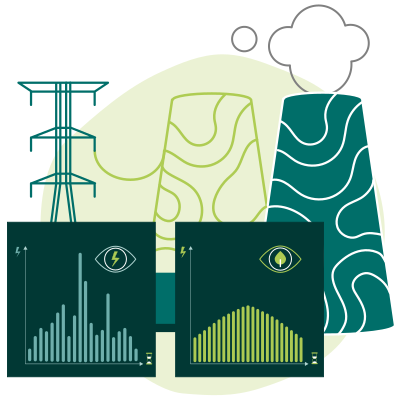
AI-Facilitated Consensus: from blank page to agreement in ten weeks
Traditional standards take 3+ years. GSF's AI-facilitated assembly process brought 14 experts from 15 organizations to full consensus on SCI for Web in just 10 weeks. Structured questions feed into LLM synthesis, with human-in-the-loop review, iterative refinement, and explicit decision gates at every stage.
Most GSF standards begin with an Assembly
Assemblies are dedicated workshops — public or member-only — where experts collaborate on a specific challenge. Whether the goal is exploration, knowledge sharing, developing a new standard, or gathering feedback, assemblies bring the right people together to move from problem to solution.

What makes a good specification
Every GSF standard is evaluated against eight quality characteristics drawn from our standards playbook.
Clarity
Unambiguous language that leaves no room for misinterpretation.
Completeness
Covers all necessary aspects without leaving critical gaps.
Consistency
No internal contradictions; aligned with other GSF specifications.
Testability
Requirements can be verified through objective testing or measurement.
Traceability
Every requirement links back to a stakeholder need or objective.
Maintainability
Structured for easy updates as technology and understanding evolve.
Feasibility
Technically achievable with current or near-term capabilities.
Prioritisation
Critical requirements are clearly distinguished from nice-to-haves.

Standards in the News
Articles, announcements, and insights from across the GSF standards program.

Green Software Foundation Launches Green Software & AI Academy, Turning Open Standards into Role-Based Skills
The Green Software & AI Academy pilot is now open to GSF members, offering fourteen courses and vendor-neutral certification built on GSF's open standards to help teams measure and reduce the environmental impact of software and AI.

Welcoming the Software Water Handbook as a GSF Project
The Handbook brings together scattered data needed to measure software's water footprint, helping practitioners and organizations apply the Software Water Intensity (SWI) specification.

What an AI Data Center Takes: Eight Questions to Ask Before We Build
Sustainability decisions around AI data centers need to happen before infrastructure is built. In the latest ED Notes, Navveen Balani proposes a framework for evaluating water, energy, land, and accountability while connecting software demand to physical infrastructure.

Beyond Watts: What Should AI Efficiency Really Measure?
In our ED series, Navveen Balani argues AI efficiency should be measured by the value it delivers. He examines how GSF specifications such as SCI, SEI, and SWI use functional units to connect compute to the outcomes we care about.

SCI for AI Bootcamp: How Four Organizations Are Measuring Their AI Emissions
This summer, Amadeus, AVEVA, Schneider Electric, and Siemens have joined GSF's first cohort to apply the SCI for AI methodology to their AI systems. We share what we've learned so far and what comes next.

Green Software Foundation Announces Intent to Launch Green Software & AI Academy to Build the Skills Needed for Sustainable AI
The GSF invites organizations to help build vendor-neutral training and certification for sustainable AI, shaping the skills the industry needs.

Introducing GSF Labs
GSF Labs gives the green software community a shared space to prototype, test, and contribute to green software solutions for new technologies across carbon, energy, water, and waste impact areas.

Turning Digital Emissions into Actionable Metrics—Meet Mei-Lian Wei of Taiwan Institute of Economic Research (TIER)
New GSF member, Mei-Lian Wei, shares how TIER brings frontline green software practices to Taiwan's digital industries, from SCI pilots to carbon calculation tools.

Measuring Software's Water Footprint: A Conversation with SWI Project Chair Yi Ding
In our Q&A, Yi Ding shares how the SWI project is building a practical standard for measuring software's water footprint to support more informed engineering and business decisions.

SCI for AI: A Framework for EU AI Act Environmental Compliance
In a recent whitepaper published by GSF's Software Standards Working Group, we map the ratified SCI for AI specification to the EU AI Act, showing how it helps fulfill the regulation's energy measurement requirements and goes further by converting energy into carbon emissions and accounting for embodied hardware emissions.

Capital, Compute, and Carbon: Banking's Three Disciplines for Agentic AI
In our article, Navveen Balani, GSF Executive Director, examines how banking's existing governance disciplines extend to agentic AI and how they could benefit from shared measurement standards.

Leadership Update: Janardan Misra elected Co-Chair of the Software Standards Working Group
In our latest Q&A, Janardan Misra (Accenture), new Co-Chair of the GSF's Software Standards Working Group and member of our Steering Committee, shares his plans and priorities in the new roles.

Watersheds and Workloads: Bringing Water into the Sustainability Conversation
Navveen Balani, GSF Executive Director, explores the unique challenges of water measurement and what they mean for decision-makers ahead of emerging disclosure requirements.

The Green Software Foundation Turns Five!
As we celebrate the fifth anniversary, here's a closer look at the milestones that shaped the Foundation into a global consortium of nearly 70 organizations.

Introducing the Software Water Intensity (SWI) Project
Launched under the Software Standards Working Group, the project aims to provide a consistent approach for measuring and reducing software's water footprint.

Tokens and Greens: Measuring the Impacts of Agentic AI
Navveen Balani shares why agentic AI has become the next big efficiency problem in software and what measuring its environmental impact across energy, carbon, and water requires from every layer of the technology stack.

Revisiting Green Software: From Silicon to Screen
The Green Software Foundation expands its vision to cover the full environmental footprint of modern software, across carbon, energy, water, and waste. Learn what this evolution means for the practitioners, organizations, and decision-makers shaping green software.

Introducing GSF Reference Implementations
The new GSF Reference Implementations repository is a community-driven space for working examples showing how to apply green software standards in practice, starting with SCI for AI applied to LLM inference.

SCI Self-Certification: A Standardized Way to Disclose Software's Carbon Emissions Data
We're launching the SCI Self-Certification program, enabling organizations to bring internal measurement into a publicly recognized disclosure, marking an important step toward industry-wide carbon transparency.

SCI for AI Specification Ratified: Standard for Measuring AI Emissions Across the Lifecycle
We're excited to announce the ratification of the SCI for AI specification, marking a major step in making the carbon footprint of AI systems transparent, comparable, and actionable.

Celebrating the Ratification of the Sustainable Organizational Framework for Technology (SOFT)
We’re proud to announce the ratification of our Sustainable Organizational Framework for Technology, marking a key milestone in the adoption of green software across industries.

Real Time Cloud Ratified: A Major Step Toward Transparent, Sustainable Cloud Computing
We’re thrilled to announce the ratification of the Real Time Energy and Carbon Standard for Cloud Providers! Learn more about the project, what this milestone means, and what’s coming next.

Calculating Your Carbon Footprint: A Guide to Measuring Serverless App Emissions on AWS
Denis Angeletta and Franziska Warncke explain how NTT Data applied the SCI specification to quantify the carbon emissions of serverless applications.

The EU AI Act: Insights from the Green AI Committee
A few member representatives on the recently formed Green AI Committee share their thoughts on the publication of the EU AI Act and what it can mean for greening AI.

Emission Calculations through Large Language Model
Srinivasan Rakhunathan and Navveen Balani share how to estimate software emissions during the system design phase using LLMs.

Software Carbon Intensity (SCI) Specification Achieves ISO Standard Status, Advancing Green Software Development
The ISO confirms that the SCI Specification is a reliable, fair, and comparable protocol for measuring and reducing software's carbon footprint, achieving a major milestone in green software.

Decarbonizing Software: How CAST applied the SCI Metric to Make a Difference
“The automatically generated Green Software Insights from CAST Highlight enabled us to identify exactly where in our code we could improve our green impact and then estimate the actual CO2 emissions savings with concrete numbers.” - Michael Muller, Director Product Management, CAST

The GSF Endorses the AI Environmental Impacts Act
How the AI Environmental Impacts Act could foster a culture of greening software and support green software projects.

Baselining Software Carbon Emissions - A Use Case by UBS
Using the SCI specification, UBS compares two banking applications with regard to their carbon emissions.

Can AI Truly Be Green?
In a recent GSF-organized panel on responsible AI, experts discussed the environmental challenges of AI, prompting a critical question: Can AI be truly green?

The Carbon Conundrum and Ethical Quandaries in the Expanding Realm of AI
In this blog, we'll provide a summary of the key messages and concepts shared in Abhishek Gupta’s latest article on The Imperative for Sustainable AI Systems, published on The Gradient.

Balancing Power and Responsibility: GSF's AI Environmental Panel Preview
GSF is holding on online event on October 5, where experts will explore how we can make AI greener and carbon-aware.

Cloud Computing: The Business Case for 100% Carbon Free Energy
The cloud computing industry is growing at an unprecedented pace. With businesses and consumers relying on cloud services for everything from data storage to application hosting, the demand for cloud computing solutions is on an upward trajectory. However, with this growth, there is a greater risk of increased carbon emissions from cloud computing.

How Accenture Implemented the SCI Specification Score to Track Software Emissions
An in depth look at how Accenture implemented the SCI Specification Score to track software emissions.

Texas State University deems GSF SCI an effective metric to evaluate the carbon impact of software
The Texas State University has just released its report on a study evaluating software carbon intensity of foundation models. Among other findings, the study confirms that the SCI is suitable for effectively measuring the carbon impact of software.

Sustainable Tech Choices for Cloud
The big three hypercloud providers need clever flexibility and targeted efficiency to achieve CZero. And the changes must come from them as well as from their users.

Why Should Sustainability be a First-class Consideration for AI Systems?
Should sustainability be a first-class consideration for AI systems? Yes, because AI systems have environmental and societal implications. What can you do to make green AI a reality?

Software Carbon Intensity (SCI): Crafting a Standard
The Software Carbon Intensity (SCI) standard provides an actionable approach to designers, developers and deployers of software systems to measure the carbon impacts of their systems.
What Do We Need to Build More Sustainable AI Systems?
AI systems can have significant environmental impact. We are risking severe environmental and social harm if we fail to make greener AI systems.