

Carbon Measurement Engine
Most organizations can estimate their total carbon footprint, but can't answer the harder question: which applications are responsible? Without that visibility, you can't engage engineers on reduction or tell them where to focus. Carmen solves this.
Most organizations can estimate their total carbon footprint, but can't answer a harder question: which applications are responsible? Carmen bridges that gap, deployable across your Kubernetes clusters and cloud services, delivering per-application SCI measurements that are transparent, auditable, and reproducible without requiring any custom implementation.
Developed with support from GSF member organizations















































From Amadeus to Open Source
In 2022, Amadeus faced a measurement challenge that many large organizations were quietly struggling with: how do you measure carbon emissions across hundreds of applications at the scale of three billion flight search requests per day? Led by Florent Morel, the Amadeus engineering team built Carmen on top of Impact Framework. By late 2023, the first dashboards were live in production. In December 2025, Carmen was open-sourced under MIT. On January 31, 2026, Amadeus transferred the repository to the Green Software Foundation, making Carmen freely available to any organization worldwide.
Read the GSF announcement →
“Carmen represents exactly what we need more of in the green software ecosystem: practical tools built on solid measurement foundations that help teams act. By building on the Impact Framework, Amadeus showed how our open standards and frameworks enable interoperability and verification across the industry.”
Asim Hussain
Executive Director, Green Software Foundation
Green Software Foundation

“Open-sourcing Carmen is our way of contributing back to the community and accelerating the development of practical, standardized tools for green software. As more organizations adopt and contribute to it, the engine is expected to become more accurate, more robust, and more useful.”
What is Carmen?
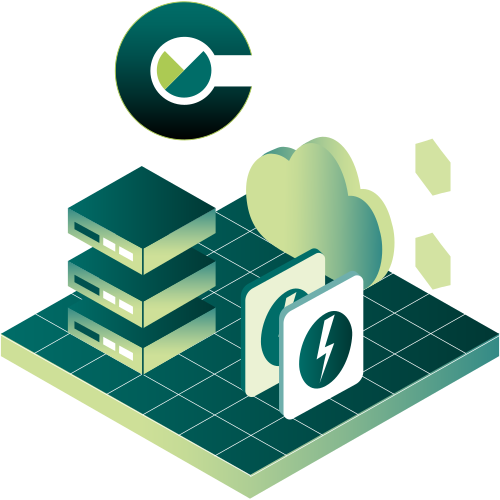
Infrastructure level: Tracks energy consumption and carbon emissions from virtual machines, storage, and cloud services.
Application level: Monitors individual applications and workloads running in Kubernetes clusters using Prometheus and Kube State Metrics, tools already running in most production environments.
Every calculation is backed by a manifest file that records exactly which models were used, so any engineer can open it and verify the numbers independently.
Two ways to deploy Carmen
Why Carmen Matters
Understanding total carbon is no longer enough. Teams need to know which applications drive the most emissions before they can act.
Industry Impact
You can estimate your total cloud carbon footprint. But without knowing which applications are responsible, you cannot engage engineers on reduction or tell them where to focus. The GSF Impact Framework gave you the methodology. Carmen gives you the infrastructure to use it at scale, across every application, every team, without months of custom integration work.

Business Benefits

SCI at scale without custom implementations: Deploy Carmen in your environment and get standardized carbon measurements across every application without writing custom measurement code

Cross-team carbon accountability: Per-application SCI scores give every engineering team direct ownership of their emissions, turning sustainability from a central concern into a distributed practice

Auditable and reproducible measurements: Manifest files record every model and parameter used in each calculation, so auditors and engineers can verify results independently

Carbon and cost in one view: CPU, memory, and network consumption drive both cloud spend and carbon emissions. Carmen surfaces these shared signals, letting one dataset serve both sustainability and finance teams
Built for Every Role
Platform Engineers
Integrate Carmen with the tools already running in your cluster: Prometheus and Kube State Metrics. Carmen's manifests slot into your existing observability stack. No new monitoring infrastructure required.
Sustainability Teams
Get per-application SCI scores that map directly to CSRD reporting requirements and internal reduction targets. Track progress across quarters with consistent, comparable measurements. Carmen's auditable manifest files give you the evidence trail needed to satisfy regulators.
Business Leaders
Validate that carbon reduction commitments are backed by granular, application-level data rather than top-down estimates. Carmen's reproducible calculations satisfy auditors and procurement teams who need to verify supplier sustainability claims.
Everything You Need to Get Started

Quickstart Guide
Step-by-step instructions for integrating Carmen with Prometheus and Kube State Metrics in your cluster.

GitHub Repository
Carmen's source code, manifests, architecture documentation, and contribution guidelines.


From Internal Tool to GSF Project
-
2022
Amadeus engineering team begins building Carmen to measure emissions across hundreds of applications
-
Late 2023
First Carmen dashboards live in production at Amadeus
-
December 2025
Carmen open-sourced under MIT
-
January 2026
Repository transferred to GSF; Florent Morel and Robin Castellon continue as project chairs
-
April 2026
Public launch webinar: Carmen available to organizations worldwide
Project Status: Carmen is production-proven at Amadeus across hundreds of applications. For the broader community, Carmen is in active development at alpha stage. Currently supported environments: Azure-based Kubernetes clusters. Additional cloud provider support is on the roadmap. The formal GSF approval process is in progress; the draft status shown in the GitHub repository reflects this, not the production maturity of the tool itself.


Get Involved
Join the community building practical, open carbon measurement tools



Related Articles
News, insights, and updates about Carmen and software carbon measurement.

Welcoming Carmen (Carbon Measurement Engine) as a GSF Project
Carmen, an open-source measurement engine from Amadeus joins GFS's ecosystem. Learn how Carmen builds on Impact Framework to deliver transparent carbon measurements, giving teams the application-level visibility needed to optimize emissions without building custom implementations.