

Shifting AI’s Trajectory—Meet Boris Gamazaychikov of Sustainable AI Group
Turning AI sustainability research into action.
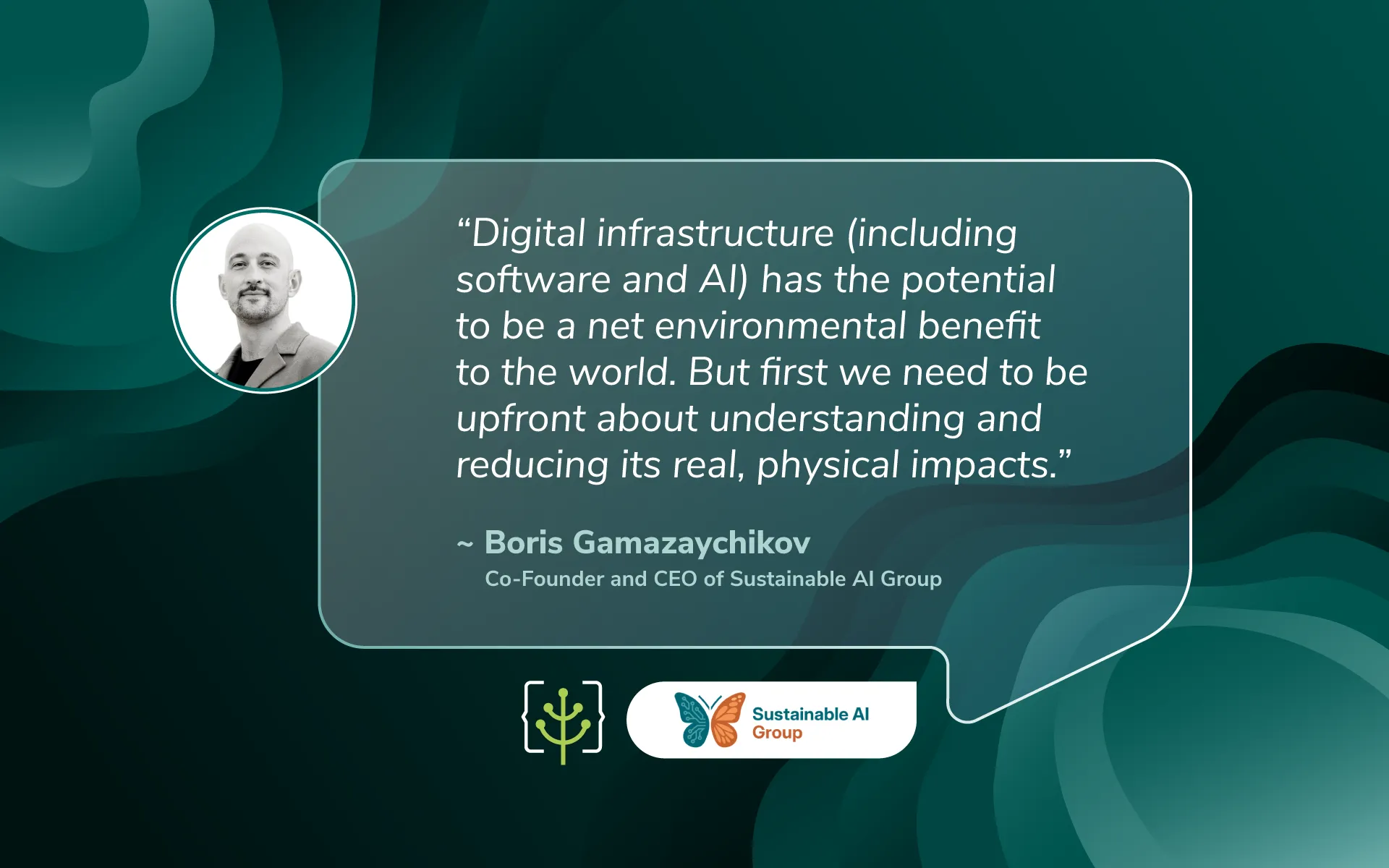
Photo: Clara Lacasse
Boris is an AI sustainability engineer focused on turning research into action inside organizations and is a co-founder and CEO of Sustainable AI Group.
Previously, he served as Head of AI Sustainability at Salesforce, where he built the company’s AI sustainability strategy from the ground up and co-created the AI Energy Score.
1. Can you tell us about Sustainable AI Group?
Sustainable AI Group (SAIG) was launched because we see AI’s current trajectory as clearly unsustainable—environmentally, socially, and economically. SAIG focuses on shifting this trajectory. To do so, SAIG performs research on the environmental impacts of AI and advises organizations on the best approach to measuring and managing these impacts. We believe that, with the right information, tools, and strategies, AI buyers can push the sector toward sustainability.
We were founded in May 2026 by Dr. Sasha Luccioni, a former Hugging Face researcher and a pioneer in the field, and Boris Gamazaychikov, a former Salesforce AI sustainability leader.
2. How does environmental sustainability fit into your organization?
Environmental sustainability is fundamental to the work we do. For example, we recently launched CLEER (Closed-model Latent Energy Estimation Range), our research-based approach to estimate the energy and emissions of closed AI models. We published it alongside a technical report that dives deeper into the methodology.
Our recent work also includes initiatives to estimate the energy footprint of AI video generation and a course explaining how to use AI while cutting its cost and carbon impact.
We are also hosting a webinar on November 4 on the CLEER approach for those who would like to learn more.
3. What do green software and AI mean to you?
Digital infrastructure (including software and AI) has the potential to be a net environmental benefit to the world. But first we need to be upfront about understanding and reducing its real, physical impacts—something that has been a challenge so far. I wholeheartedly believe software and AI can be sustainable, but we have to actively work to make that happen.
4. Why did Sustainable AI Group join the GSF?
We have been fans of GSF’s work for years and have lots of respect for their role in bringing together stakeholders and developing consensus around standards. As we work on quantifying the environmental impact of AI, there is a natural fit with Software Carbon Intensity for AI (SCI for AI) and other work around measuring and reducing software emissions.
5. How are you hoping to contribute to and benefit from your membership?
We aim to bring our experience in AI energy and emissions measurement, including our research on both closed and open models, to support GSF’s mission. We are excited to join the conversation with GSF member organizations and hope to contribute to discussions around SCI for AI and anything else AI-related!