
Building Sustainable Systems by Design—Meet Dr Karthik Vaidhyanathan of the International Institute of Information Technology Hyderabad
Where sustainability is the foundation, not an afterthought.
As an assistant professor at the Software Engineering Research Center of IIIT Hyderabad, Karthik leads the SA4S (Software Architecture for Sustainable and Self-Adaptive Software Systems) research group. He is also a leadership member of the Smart City Living Lab.
In his research, he focuses on making AI-enabled systems more sustainable across various dimensions (energy, cost, maintainability).
Can you tell us about the International Institute of Information Technology Hyderabad (IIITH)?
IIITH is an autonomous university founded as a not-for-profit public-private partnership (N-PPP) in 1998 and is the first IIIT in India under this model. Over the years, the institute has developed strong research programs in various areas, with an emphasis on technology and applied research for industry and society.
The institute has adopted a research-centered model, and unlike traditional academic institutions, it is organized around 25+ research centers. This structure promotes interdisciplinary collaboration and puts research initiatives at its core.
How does sustainability manifest in your organization?
Sustainability has been an integral part of IIITH’s culture and operations from the start, and it is demonstrated in our activities.
Through the Smart City Living Lab initiative, the institute has been transformed into a live test bed for any smart city. Approximately 350 IoT sensors are deployed across the campus to collect data on carbon emissions, energy usage, water consumption, air quality, and other key metrics. The data we collect will be applied to improve social, economic, and environmental value domains across urban regions.
By leveraging Digital Twin technology, we’ve developed systems to predict water leakages, optimize water pumping, and prevent waste. These efforts are especially crucial, given that we are located in a water-stressed region. Through sensor-monitored air conditioning usage, we can optimize energy consumption and reduce costs. We also continuously track energy generation vs. consumption and carbon credits.
At the SA4S group, most of our work focuses on developing approaches to reduce the digital carbon footprint of software systems.
In addition to measuring and reducing our environmental impacts, we aim to put societal work at the center of our activities. The Raj Reddy Center for Technology for Society focuses on accessibility, rural education, and making technology available to diverse language groups and communities in rural India.
Our 66-acre campus is home to over 5,000 trees, which create a 2-degree temperature drop when entering the area. After recent construction works, some trees have been replanted, maintaining a diverse and rich ecosystem.
Why did you join the GSF?
At IIITH, we strongly believe that sustainability cannot be an afterthought. By embedding sustainability practices in the design process, we can ensure that we build truly sustainable systems.
GSF’s approach aligns with this vision. By creating a much-needed platform connecting policymakers, business leaders, developers, educators, and scientists, it engineers change from both top-down and bottom-up. We need to unite both to make a significant impact.
Joining the foundation is also a key step towards developing green software standards and best practices that everyone can adopt. The work that GSF is doing here is significant.
Similar to what the Linux Foundation did for Linux, GSF creates a community that can pioneer and disseminate knowledge about clean and green software, while addressing the growing challenges of power consumption. Our aim is to actively contribute to building this community.
What does Green Software mean to you?
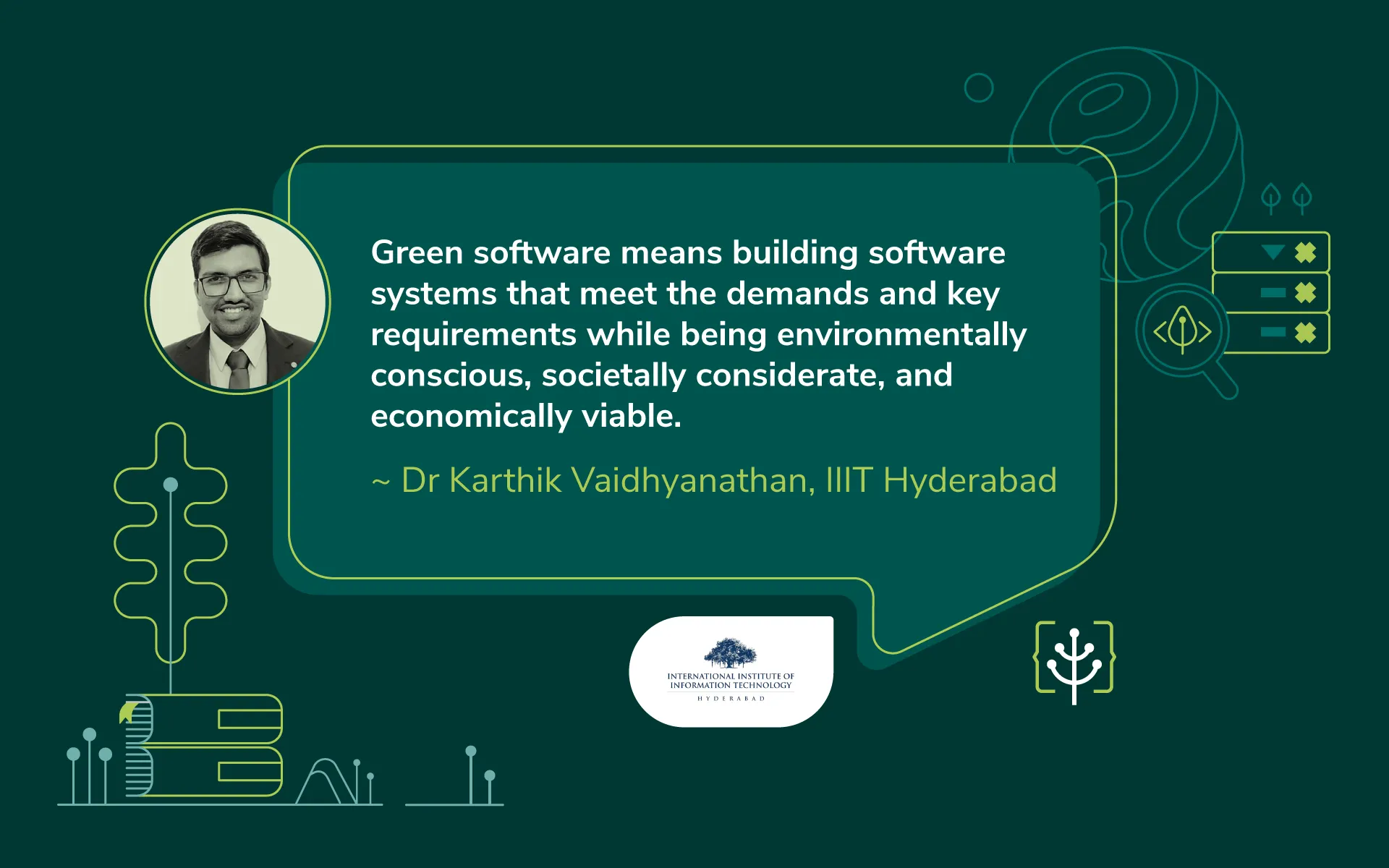
Green software goes beyond reducing energy consumption or carbon footprint. Implementing green software principles means building software systems that meet the demands and key requirements while being environmentally conscious, societally considerate, and economically viable.
Applying this in practice, we shouldn’t compromise functionality for sustainability but rather find intelligent trade-offs (e.g., accepting lower AI accuracy in some situations to save energy). Furthermore, we need to be mindful of infrastructure choices for energy-intensive tasks, such as retraining ML models, and take on a holistic approach, considering all dimensions of sustainability in software design and operation.
Are there any other sustainability initiatives that you can share?
As a dedicated research group, SA4S, we’re working on several initiatives:
- We collaborate with Lloyds Offshore Global Services Private Limited to develop methodologies for sustainable software design and development.
- Through EdgeAI labs, we work with Qualcomm exploring edge AI optimization techniques that enable battery-conscious AI for mobile devices.
- We were part of the recently released GreenAI research agenda paper. Moreover, our recent work on the energy efficiency of Code generated by LLMs, in collaboration with the S2 Group at VU Amsterdam, was accepted into a top-tier conference.
- HarmonE: a mechanism we’re building to make MLOps more sustainable by optimizing how AI models are monitored and updated in production.
- Eco-MLS (Ecological Machine Learning Systems) and EdgeMLBalancer: We’re creating a system that dynamically switches between heavy and lightweight AI models based on context and energy availability, improving efficiency across diverse environments.
- We’re also building microservice routing systems that intelligently direct requests to data centers or regions powered by renewable energy sources like solar, as opposed to fossil fuel-powered zones.
Our achievements and efforts have been recognized, and we were recently awarded a Prime Minister’s Early Career Research Grant for a 3-year project, SustAIned, to create a sustainable AI systems framework in India.
In addition to key research initiatives, we place great emphasis on education. We mentor research students in sustainable software development and aim to develop courses in green software inspired by the best practices from the GSF and institutions with which we’re collaborating, including VU Amsterdam and the University of L’Aquila.
How do you hope to contribute to and benefit from the GSF?
We aim to contribute to the GSF’s efforts by applying our research expertise, particularly in areas such as runtime sustainability monitoring and adaptive systems (beyond just design-time considerations), as well as in supporting key initiatives, including the Software Carbon Intensity (SCI) for AI.
While we see a strong interest in sustainability among our students, rising awareness remains a key consideration. Through courses and student mentoring, we want to translate research outcomes and best practices for the next generation of developers.
In order to fulfill this objective, gaining insights from GSF’s diverse community is invaluable, as is the opportunity to incorporate GSF materials and standards into educational offerings.
We envision this collaboration as a two-way flow between the institute and the GSF community, enabling knowledge exchange and cooperation across working groups and standards development, advancing green software practices across research and industry.